COGS: manufacturing cost, predicted in seconds.
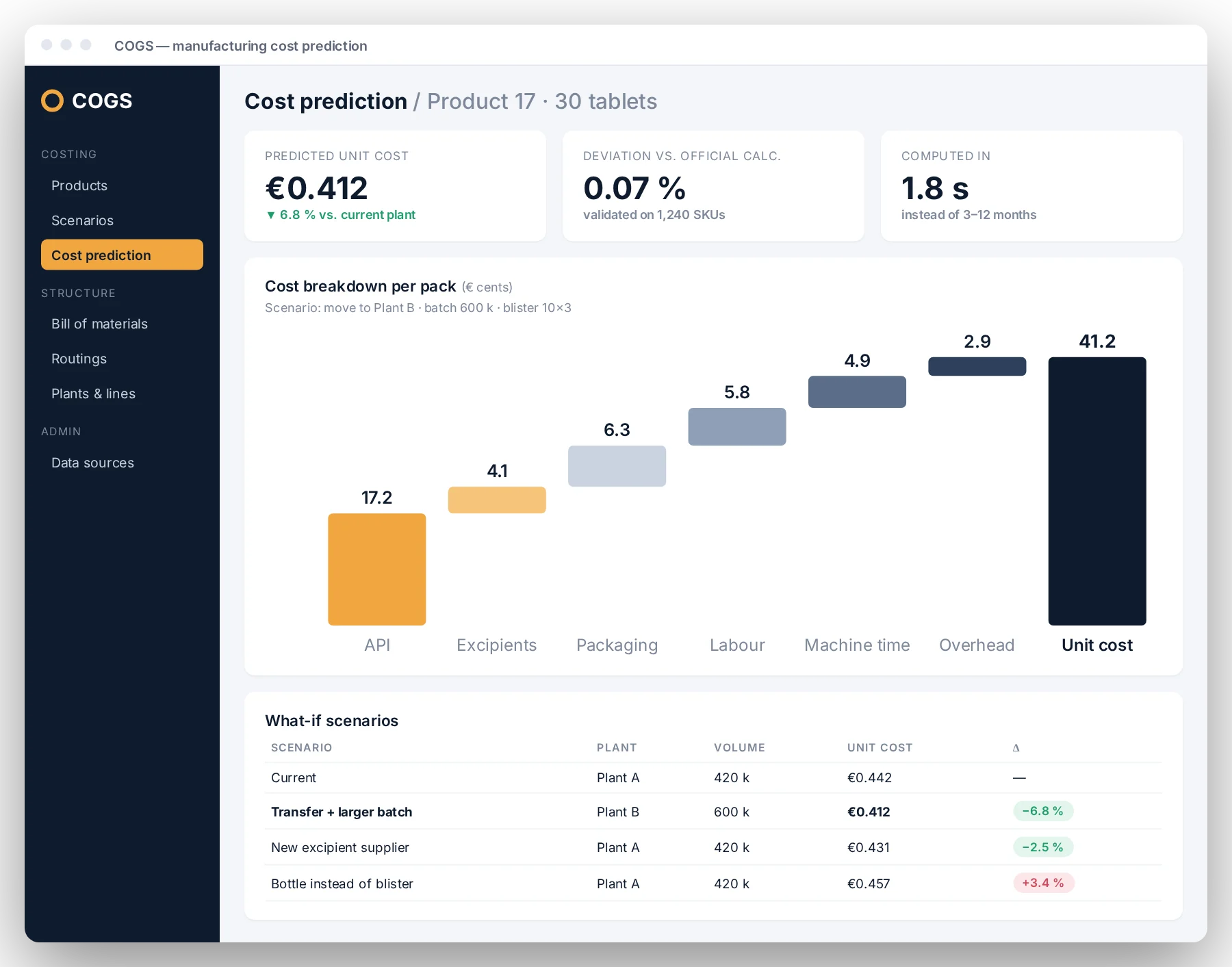
An AI model of your production costs. Change the formulation, the machine or the volume and see the unit cost instantly. Built and proven in pharma, the principle works for any manufacturer with a bill of materials and a routing.
For generics, cost of goods is 50–65% of net sales.
Prices only fall after launch. Knowing the cost of every formulation and process change precisely decides the viable price and the portfolio.
Questions COGS answers in seconds
For production, controlling and finance alike.
- What does a change in formulation do to unit cost?
- How does a faster machine or a new line change the cost?
- What is the unit-cost impact of scaling production up?
- Investments: does a new machine on this line pay off — or is the money better spent on packaging?
- Line allocation: which products pay off best on which line?
- Plant allocation: what should we make where?
- New products: what will it cost to make — and where is it cheapest to produce?
How COGS produces a verified number.
From analysis to production in 5–8 months.
Analysis
Your COGS calculation, use cases and a rough accuracy estimate.
Proof of concept
The first model on your data, with measured accuracy.
MVP
The model in the platform; users estimate for real.
Production
Full deployment, tested with key users.
Finalist and podium, Digital Future Awards 2026.
Frequently asked questions
What is COGS by DNAi?
COGS is an AI platform that models the cost of the whole manufacturing process. It predicts the manufacturing cost of a product in seconds after any change in formulation, process, volume, packaging, plant or technology.
Is COGS only for pharma?
No. We built and proved it with a pharmaceutical manufacturer, but the principle is generic: any manufacturer with a bill of materials, a routing and a cost calculation can have its own cost model — food, chemicals, cosmetics, engineering and more.
How accurate is it?
Less than 0.1% deviation from official controlling calculations on standard product changes, at a European generics manufacturer.
How long does implementation take?
From analysis to production in 5–8 months: analysis (1 month), proof of concept (1–2 months), MVP (1–2 months) and production (3 months).
Who uses COGS?
Production and R&D to see the cost of every formulation and process change; controlling and finance to decide investments — a new machine, a new line or packaging — and to allocate products to lines and plants; product teams to know the manufacturing cost of a new product and where to make it.
What do we need to start?
One product with its bill of materials and routing, and your current cost calculation.