Legacy modernization with AI: your core system, rewritten — and yours.
AI agents on the DNAi platform reverse-engineer legacy code into a complete, verified specification, then migrate it to a modern platform with provably the same behaviour.
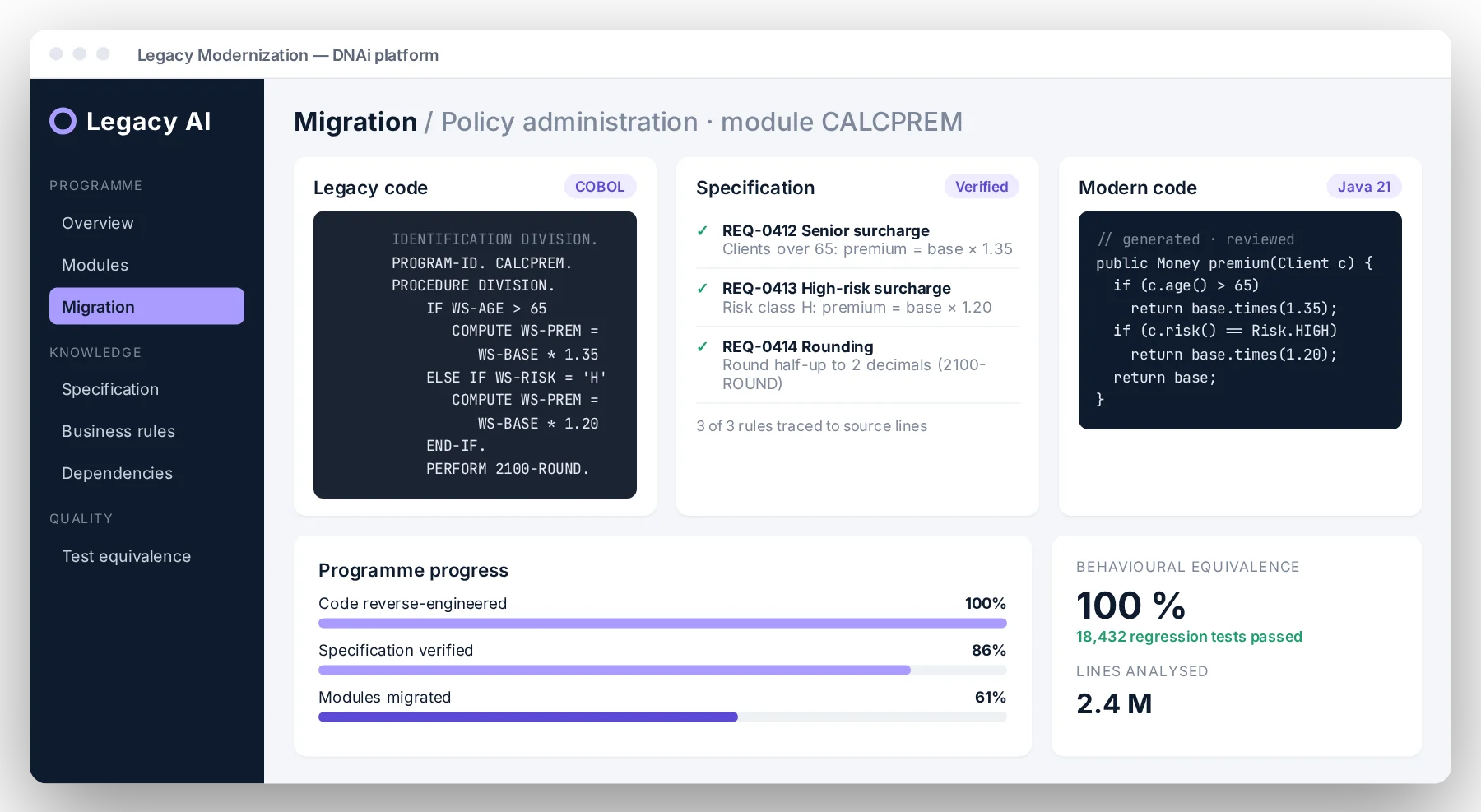
Your critical system is also your biggest risk.
It keeps the company running — and holds it back. The longer you wait, the more it costs. The old software stack is by far the smallest problem.
Knowledge in a few heads
The people who understand the code are retiring. When they leave, nobody knows how it works.
Vendor lock-in
You pay a lot to keep an outdated system alive with one supplier, often without access to the source code.
A brake on growth
Every change is a risk, its impact cannot be estimated, and larger development is slow and expensive.
Maintenance eats the budget
A large team just to keep the system alive. Money goes into maintenance, not development.
From old code to a modern system.
It is not “just run GPT on the code”.
- A nice demo — but often not sustainable or not working in production
- Hallucinations and inaccuracies; nobody vouches for identical behaviour
- General LLMs lack training data for languages like LANSA or RPG
- Large hidden costs to finish it for production — and it may still not work
- Rewritten against a complete specification, not by eye
- Test-driven: identical behaviour verified on real data
- Actor-Critic: one agent creates, another checks the quality
- Deterministic where possible, AI only where needed — accurate and safe for production
Systems nobody wants to touch.
- IBM i (AS/400): RPG, CL, DB2, LANSA, Synon/2E
- Mainframe: COBOL, PL/I, CICS, IMS, Assembler (HLASM), Natural/ADABAS, IDMS
- Older platforms: VB6, classic ASP, early .NET Framework, Oracle Forms, PowerBuilder, Delphi
An almost 100% complete, consistent and detailed description of the system.
- Functional requirements and acceptance criteria (Gherkin / BDD), one scenario per rule with concrete data
- Use cases, user flows and screen flows — screens reverse-generated into Figma
- Rules, validations, invariants, side effects and edge cases; entity lifecycles as state machines
- ER models, non-functional requirements and AS-IS architecture views
- Optimisation on the way: duplicate functions, bugs, inconsistent processes and duplicated data found
A one-day workshop and a joint business case.
We assess your system
What it contains, what holds it together and where the risks are.
We propose the rewrite
What we can rewrite, how, and to which modern platform.
We calculate the business case together
What it costs, what you save and when it pays back — in one, two, three years… or not at all.
Honestly: if it does not pay off, we will tell you. We only want projects that make sense.
Frequently asked questions
Which legacy systems can DNAi modernize?
IBM i (AS/400) with RPG, CL, DB2, LANSA or Synon/2E; mainframe COBOL, PL/I, CICS, IMS, Assembler, Natural/ADABAS and IDMS; and older platforms such as VB6, classic ASP, early .NET, Oracle Forms, PowerBuilder and Delphi.
Is this just running GPT on old code?
No. AI agents first reverse-engineer a complete specification with tests, then rewrite against it. An actor agent creates and a critic agent checks quality; tests on real data verify identical behaviour after every change. Deterministic tools are used wherever possible.
How much can it save?
Early results show 50–90% lower migration cost than a classic rewrite. The investment typically pays back in two to three years, sooner for suitable systems.
How do we start?
With a one-day workshop: we assess your system, propose how to rewrite it and calculate the business case together. If it does not pay off, we tell you.